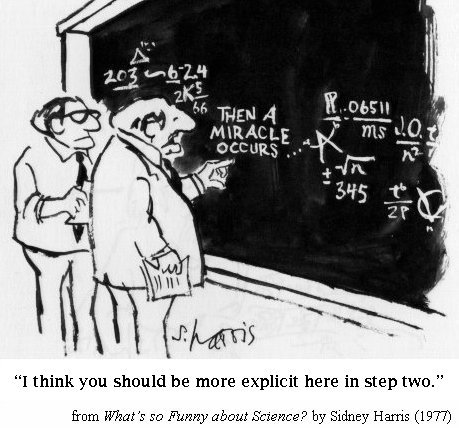
This week in math class there was a large focus on multiple solutions. When solving a problem posed in class, multiple groups answered it defferently, just how we did back in week 2 with the frog question. Some students solved the question with a formula algebraicly, while other groups, such as my own, used a more visual set hold when solving the problem. This ties into again that main idea of creativity in math and how all learners view things differently and think things through differently, in regards to math or any other subject. This highlights the importance of students showing their work in class. I believe math is about problem solving, not just that final answer. Showing our work as students is important because it shows our creative process and problem solving skills. It is a visual representation of our minds at work. Also because not all of us solve problems in the exact same way, we need to see that process in order to understand and give credit for the work being done. For example, in class a specific student was having difficulty understanding the process of how one group went about solving a problem. Just by simply looking at the formula written on the board, it meant nothing. After that group walked the student through the mathematical process that they took, they had understood! This is a great example of why showing our work is important, so that we can understand the process going on in someone else’s mind.
Important Reasons for Showing Your Work:
- helps students organizes thoughts and decreases chances of mistakes
-you’ll know where you went wrong
-you’ll understand the process
-you’re working on your problem solving skills
-it will help you understand the mathematical problems better!
“Instead of trying to make children
love the math they hate, make a
math they’ll love.” -- Seymour Papert
One huge theme that we have been discussing and keep coming back to in math class is how there is this idea of how students hate math and how can we get our students to enjoy math. It is in fact true as research has shown that students do dislike the subject for many reasons, such as, math is hard, boring and irrelevant. This research also tells us a few more things: - these negative attitudes affect the students ability to learn the subject - it is never too early or late to improve this relationship - we as teachers can improve our students motivation by getting our students interested The quote at the top of my blog post really resonated with me. Instead of focusing (and wasting time) trying to force our students to enjoy something that they hate and trying to convince them that what they should love what we are etching them, we should shift the focus to teaching them something in a way that they will love it. According to this article by Tara Dusko, here are 5 fun ways to get your students to love this disliked subject:
1. Teach studnets to have a growth mindset We need to have our students know and think that they can get better at math. We need to eliminate their fixed mindset of thinking they are hopeless and just naturally terrible at math. 2. Try guided math
To eliminate students from thinking that math is boring, we need to change up our math class structure and delivery as teachers. Do this by using mini lessons and student centred learning.
3. Get your students moving and collaborating
Create an interactive math classroom and get the students to work together to solve problems. Use clue and activities where students need to use their peers in order to solve these math problems.
4. Play fun math games Kids love games, they are fun and interactive and are a great way to engage your students. 5. Use technology
Technology is also a fun and interactive way t engage your students while also making math relatable to them. There are tons of great websites and apps such as Prodigy that students will be able to enjoy themselves and learn math at the same time.
From personal experience, just doing the interactive activities and collaborative activities in my math class have really allowed me to be more interested in this subject and more involved and excited to work during math class. Just chasing how we go about teaching math to our students can make the biggest difference in their active participation within the class.
Overall, throughout this math class we also focused on other big ideas and themes. These themes included busting myths in mathematics and focusing on creativity in math, meaning how students should feel free to explore mathematical problems and solve questions in a way that meets their needs, as there is more than one way to solve math. This is the theme that I will be focusing on the most moving forward as a math teacher and in my future placement. I strongly agree with what we have discussed in class as well as strongly believe in students having the knowledge and ability to do things in the way that they best relate with. In my future classrooms I hope to be able to encourage students to all have a different view point on a given mathematical problem so that they may be creative thinkers in the process of solving problems to solve it in a way that resonates with them. By hopefully doing this in my classroom, I ill also hopefully be able to eliminate the ideas that all students "dislike" math and create a positive math environment where students enjoy working through problem sin their own creative way.
This week in math class we continued looking at problem solving skills and strategies and how each students has their own unique ways of doing this. This weeks problems involved the use of manipulative and algebraic reasoning, or in other words, patterns. Algebraic reasoning is based on our abilities to recognize patterns and generalize from them, and to me, almost like decoding. We were given different patterns i class and asked to recognize them and "decode" what the pattern was, and use this technique to determine what the pattern would look like if it was to continue to a given number position. In order to help students visualize this, we were looking images and also given tiles to manipulate and get our hands on at making our own patterns. We also used gallery walks to look at our peers patterns to try and solve what the pattern was that they had created with their tiles. I like this technique as it allows you to explore what other students and your peers are doing and gain a different perspective on the questions that you were also answering. This shows you that there are multiple ways to do mathematics and solve problems and that their infect is a creativity component to mathematics just as we explored during the online modules this week. As Junaid Mubeen states in his post,
"Mathematics must be creative, else it isn't mathematics".
Creativity is describes as the ability to join seemingly disparate ideas to form new expressions and thoughts and emotion, which is exactly what you are doing while problem solving in math. Math is all about discoveries in regards to patterns and symmetries and using what knowledge we know to continue to make new discoveries. Based on this, critical thinking and creative thinking are essential to do math and all students are capable of this as they develop the knowledge and skills to further do so. As Matthew Oldridge says on his blog, "creative thinking: making something new, critical thinking: making sound judgements". Overtime a student does a mathematical problem, they are making something new by using their own patterns and strategies in a creative way. To arrive at an answer, students are also checking their work and testing to see if they are infect correct in solving the problems and if their processes worked - by being critical thinkers.
This week in math class, we participated in an activity where I really noticed the different types of learned and multiple intelligences. This lead to a discussion on how everyone views things different. We may not be right or wrong but everyone has their own point of view on tings and this is important to take into account as we are all unique and individual learners. The activity that generated these thoughts was an activity about frog races. We were given a problem that was to be solved in regards to the frogs jump length. There were two main ways that the class went about solving this problem. One was was with numbers and a formula, the
algebraic way. The other way, which I found myself using, was though a visual representation of drawing out the mathematical problem. This is the way my partner and I thought to solve this equation:
This shows that we solved this problem though using a visual aid. Originally, we didn't not even think to use number or a formula. Our first instinct was to simply draw out the "jumps" to better understand what the problem was asking and then apply numbers to. This brings up how important the idea of differentiating your math instruction is as not all students think the same way. We as teachers need to provide opportunity and problems for our students in which they can be creative with a use their own ways of thinking. We need to teach our students multiple different ways to solve math problems so that they can find which way works best for them. According to the post by Jessica Boschen, these are her reasons as to why she should teach multiple ways to solve math problems to our students:
TEACHING STUDENTS MULTIPLE STRATEGIES HELPS STUDENTS CHOOSE THE MOST EFFICIENT STRATEGY FOR THEMSELVES
We want our students to be confident about their math and pick a way that resonates with them.
Teaching different strategies will help them see different ways to solve problems and students will gravitate to the way that best meets where they’re at, making them more efficient mathematical thinkers.
TEACHING STUDENTS MULTIPLE STRATEGIES PROVIDES SCAFFOLDING SO THAT THEY CAN FIND A PLACE THAT MEETS THEIR NEEDS
We want our students to explore different strategies in order to be able to find what works best for them.
TEACHING STUDENTS MULTIPLE STRATEGIES MOTIVATES STUDENTS TO WORK AT SOLVING PROBLEMS
There are many students who don't think they're good at math or simple just hate math. Multiple strategies allow students to solve it at their level and do it in a way that they enjoy, making them more motivated to do math.
This is why we need to provide out student with multiple ways to solve problems and allow them to be creative in solving their problems as all students view things differently and different strategies work for each student. We are all unique learners!
Week 2 This week in math class we took a look at the following math problem "bagging eggs".
After being given time to discuss this problem with our peers in our groups, we were asked how we went about solving the problem and how we arrived at our answer. What was interesting to find was that everyone in the class had solved the problem in the exact same way using the same methods. However, this would not be the case with our students in our own classrooms. Many students solve math problems in different ways and have many different approaches to all sorts of problems. This is intact a good thing as they are using their problem solving skills, as there is no such thing as there only being one right way to do a math problem or a better way of going about it. It depends on the individuality of each students and the way the view problems and use their problem solving skills. This connects with our reading of how proficiency is not all or nothing. Every mathematical idea can be understood at different levels and in many different ways. This proficiency develops over time as students as students engage in the mathematical activities around them. How we can improve this in our students is through the idea of mindset, which we also discussed this week. We as teachers need to promote the growth mindset in our students and create a positive attitude towards math so that they understand if they study and work hard at the subject they will succeed. We also need to encourage our students to be creative with math. It has been believed that math is not a creative subject - as discused last week with our math myths- but it in fact is. This is true as there are many ways that problems can be looked at and solved and we need to help our students to feel comfortable to find the way that best speaks to them and how they feel comfortable doing math. In order to make this possible, we as teachers must focus more on the theory of math and getting our students to understand the problems and be able to think critically, rather than teach them a formula. One question I still do have following this weeks sessions is what are the techniques used to promote this type of thinking in our students? Is it simps from the question and problems we provide our students with the opportunity to solve or are there specific techniques and skills to promote critical thinking and a deeper understanding of the content.
Hello and welcome to my blog! Im Shawna, a second year J/I student a Brock university. Throughout this page on my blog, I will be reflecting and exploring the ideas we discuss and uncover during my journey through my mathematics course. Week 1 This week in math class, to start off our first class of the year, we discussed everyones feelings towards math. We discussed our fears, our excitements, our history as math students and how we felt about becoming a math teacher. The most common comment made I found was that peers expressed how they had always disliked math when they were in school. Because of this dislike, they found that they felt the most worried about teaching this particular subject. This ties in to what we explored this week during our online class activities. We explored this "dislike" towards mathematics and why so many people and students felt this way. There are many different and common reasons according to Patrick Bet- David such as: -its a new language the people don't have the patience to learn -they don't care or see the importance of why they need to know mathematics -its "cool" to hate math -it takes a lot of thought and problem solving skills -there is a right or wrong answer which does not have much room for debate -they had a terrible math teacher that did not help them learn to think and problem solve
This discussion allowed for deeper thought into this topic and how we can make sure we as teachers make math meaningful for students. Making math meaningful for students can be done easily according to these teaching secrets by Cossondra George: -creating real life examples of the concepts you are learning so that students see how math can infect be used in real life to better understand the concepts in their brain -use small group presentations of students to teach each other math as you learn something better when you are teaching it and it forces you think think stronger and deeper about the concepts being studied -ask students if their answer is logical as this will allow for critical thinking and for them to actually understand the meaning of the problem being solved, rather than knowing how to use a formula -use technology to engage students to allow for interactive math activities - have studnets rework problems they missed to help them learn to identify their mistakes By making math more meaningful for students, hopefully this will allow to eliminate the "dislike" students feel towards math and allow our students to fully engage and grow within the subject.
Having strong communication skills are
crucial in life for both personal and professional reasons.
Oral communication, according to the Ontario Curriculum is defined as; through
talk, students not only communicate information but also explore and come to
understand ideas and concepts; identify and solve problems; organize their
experience and knowledge; and express and clarify their thoughts, feelings, and
opinions. Listening and speaking skills are essential for social interaction at
home, at school, and in the community.
The Oral Communication strand has three
overall expectations, as follows:
Students will:
1. Listen in order to understand and
respond appropriately in a variety of situations for a variety of purposes
2. Use speaking skills and strategies
appropriately to communicate with different audiences for a variety of purposes
3. Reflect on and identify their
strengths as listeners and speakers, areas for improvement, and the strategies
they found most helpful in oral communication situations.
The curriculum also states that in order
for students envelop their oral communication skills, they need numerous
opportunities to listen and to talk about a range of subjects, including
personal interests, school work, and current affairs.
Since good oral communication skills are
so important, how can we actually improve these skills? According toDay Translations, here are 12 ways:
1. Listen well and avoid
interrupting
In order to become a better
communicator, you must first become a good active listener. By being able to
understand the message better, you’ll be able to provide a better quality
response. This applies directly to overall expectation #1 as students need to
listen in order to understand.
2. Practice paraphrasing
Being able to put things into your own
words ensures you got all the details right and allows you to see if the
information actually makes sense to you or not. This applies directly to
overall expectation #2 - paraphrasing is a speaking skill and strategy to help
them communicate with different audiences.
3. Be Mindful of minor details
in the content
What may seem like a minor detail,
actually in fact may make the biggest difference.
4. Note the quality of your
voice, tone and pitch
When speaking, it is important to use a
voice that is the right tone and pitch to make sure that you effectively send
the right message to your audience. This also relates directly to overall
expectation #2 and adjusting your tone and pitch is a speaking strategy that
can be adjusted based on your audience.
5. Always use accurate words
to express context
Always make sure you understand the
points that you are trying to share as accuracy prevents any misunderstanding.
6. Practice completeness and
clarity in message delivery
You can’t just give your listener
half-baked information that leaves them hanging.
7. Learn to spot the most
important part of the message
Paying attention to the most important
part of the message can make a difference and being able top ick out these
points is a very beneficial skill to develop. This meets overall expectation
#1- active listening to pull the most important information out of a speech.
8. Use the right speed or
pacing when you talk
Effective communicators don’t speak too
fast or too slow and know how to pause for emphasis to both engage your
listeners and increase their understanding of what you’re trying to say. Once
again, overall expectation #2 - pacing is a great speaking strategy to change
up your dialogue.
9. Practice appropriate
gestures
Hand gestures, as well as eye contact,
are a great accompany to your speech to emphasise your point and create more
engaging speech. Overdoing it however isn’t great – we want our listeners to
connect with us and understand, not feel awkward and distracted.
10. Ask questions
Asking questions is always encouraged so
never hesitate, especially to avoid any misinterpretation. Asking questions
relates to overall expectation #3 - reflect on what you know, or don't know, in
order to improve.
11. Avoid beating around the
bush. Get to the point.
Unnecessary words don’t help get the
meaning across - they just confuse our listeners.
12. Have a full grasp of whom
you are talking to
Knowing your audience is the most
important thing. By knowing your audience you can shape your speech and your
pace and know how to connect with your listeners.
Still want more tips on how to improve
your communication skills? Here is a great video byImprovement Pill with some great tips to
develop great skills:
Now that we know some tips on how to
improve these skills, you might be asking yourself "but how exactly can I
do this?" These are some ways courtesy of theGlobal Digital Citizento specifically work
on improving these skills and can be used to help develop these skills in your
students:
1. Watch films that model
conversation skills
-Effective conversations include a give-and-take
exchange that consists of the following elements:
-body language
-eye contact
-summarizing
-paraphrasing
-responding
2. Use technology - Especially in these times, there are an unlimited amount of
resources you can use from audiobooks to apps to help improve student
communication skills.
3. Reinforce active listening -Communication isn’t just about speaking; it’s also about
listening. Teachers can help their students develop listening skills by reading
a selection of text aloud, and then having the class discuss and reflect on the
content.
4. Group presentations and
assignments -Team-building exercises can
also help students sharpen both oral and written communication skills. Not only
does it offer students the chance to work in small groups, thereby reducing
some of the pressure, but it also gives them the opportunity to debate their
opinions, take turns, and work together towards a common goal.
5. Ask open ended questions -Open ended questions are vital for inspiring discussion and
demonstrating that there are multiple ways to perceive and answer a question.
You might set a timer for short informal conversations and challenge students
to use open-ended questions.
Communication is an important skill for
every student to master, especially in order to better yourself and advance in
the future.